Saturday, October 9, 2010

Soccer and Poetry


Opening Days:  Sports Poems by Lee Bennett Hopkins is another of my favorite books.  Something about the poetry, the artwork, the thrill of reading, the sport... draws me in!  I love reading these poems with students and listening to them read aloud with prosody... the tone, the emphasis on certain vowels, the pitch, the syllable length!  And we worry about fluency... all we have to do is practice with a poem or two! 
     One of my favorite poems is "Soccer" and that's where I will be today, watching my daughter play.  She loves the game and she plays with such grace with her gazelle-like legs.  Watching her play is like reading a poem by Lee Bennett Hopkins... she punctuates with her toes, kicks each side kick with execution, stops on a dime, such precision in the scores!  She plays with athletic prosody (I made that up).  Watching your children on the field is a wonderful treat!
     But as I type this (on Friday night), I look over and see a reader lying on the couch.  The television's off.  The house is quiet.  And we are both at work... reader and writer... enjoying the pleasure of the sport! 
 
Soccer

Twenty-two
prayers
on
reverent grass.

kick
and
dribble
trap
and
pass--


sprint
and
run
tackle 
and 
fall--

all
for
the
love
of
the
sacred
ball.

This is a picture of her in action, by the way!


Friday, October 8, 2010

A Sensagoria

I was cleaning the library upstairs a bit and found my copy of Voices from the Wild by David Bouchard in one of my bags.  Whenever I travel, I always toss it in my bag.  It's the perfect book of poetry to use with any thinking strategy... it's provocative, thought-provoking, and unusual.
     I got this book in 1999 from a student who had just begun to develop Stargardt's Disease.  Since that time, he's gone on to college to pursue a degree in engineering, he's hiked in the Andes, and runs in races.  He doesn't let his disability deter him.  When he was in my classroom, there was little technology for students with visual impairments, but I remember him as a gifted writer.  I think it's ironic that the book he gave me that year was a "sensagoria" about relying on senses to survive.
     Each section of the book deals with a specific sense in mind.  Written in first person, the poetry is rich in detail.  Each poem tells how animals use their senses to hunt and avoid being hunted.  The illustrations are beautiful.  We learn how animals rely on their keen senses to survive.
     I use several poems in the book for inferring, determining what's important in text, and creating sensory images.  It's beautiful and simple... and not easy!  I love this poetry book.  And, whenever I open it, I remember that one of my students, who himself relied on other senses to succeed gave it to me.  I wonder if he remembers?

Thursday, October 7, 2010

Fleabag...

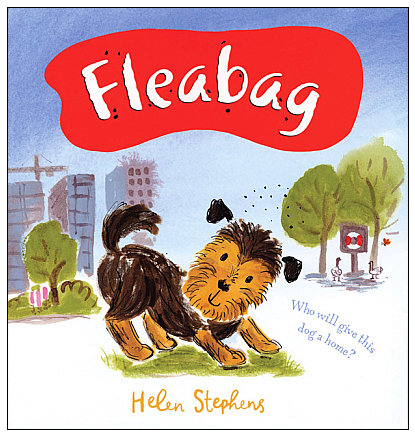
Fleabag by Helen Stephens was another irresistible book I picked up on my recent book shopping jaunt.  Why?  One reason.  My 12-year-old.  I immediately thought of her when I picked this one up!
     My daughter has been begging for a dog since she was old enough to point!  She devours books about dogs.  There's an audible "Ahhhhh" each time we see someone walking a dog.  Once, when she was about five, she got a heart-shaped pad of sticky notes from Granny (Thanks, Granny) and left at least 75 notes around the house--refrigerator, toilet lid, bookbag, computer screen--"Dad, a dog would be nice!  Woof, woof!  I think we need a dog!  Have you seen my puppy?"  And, I won't even mention every dog we've seen online on Big Dogs, Huge Paws or at the pound that is looking for a home.  Trouble is... much to her chagrin, we still don't have one (although we came close with a Newfoundland puppy last year)!  Instead, I buy great books about dogs... it's a long story!  I know what you're thinking... I may just have to give in soon (No mean dad comments... it's just that two of us can barely breath now)!
    Fleabag is a quaint story about a homeless dog that is "found" by a little boy named Bob... "A boy without a dog and a dog without a boy meet each other in the park."  I loved this story, it almost tugged hard enough at my "we need a dog" heartstrings to consider getting one... almost!  The illustrations are wonderful and full of whimsy... who knew you could say so much with two little black dots on a scruffy puppy!
     Hasn't every child at one time or another gotten a puppy, found a lost animal, "ran away" from home, or looked longingly in the pet shop window--this is the perfect book to activate a "memory" write for young writers.  The premise is familiar and weaves a wonderful tale that I think could inspire young writers to do some writing in their writer's notebooks.  Fleabag will be the perfect nudge. 
    Fleabag ended up getting a permanent home with his new family in the book and Fleabag will be the perfect addition to your permanent collection of "Books about Pets" in your classroom!

Friday, October 1, 2010

Happy 60th Birthday

How did you become a reader?  I was a comic book reader.  Comics featuring Peanuts were my favorites.  Each week my mom and I would trek to the local drug store and purchase the newest collections... Dennis the Menace or Charlie Brown and the gang!
     Tomorrow, October 2nd, is the 60th anniversary of the syndication of the Peanuts cartoon strip.  I couldn't let it slip by without a recognition.  Charles M. Schultz was a master.  It was reading Peanuts each day in the newspaper (my collection of comics also) that turned me into a reader.  I read each comic carefully, drew my own inferences, and had wonderful conversations with my mom about the intricacies of each frame.  I learned about the beauty of language play from reading comics.  I learned to write a complete sentence by creating comics of my own.  I learned about humor.  Each drawing gave me a nudge to think deeper... the subtle twist of a smile, the "movement" marks in the background, the complexity of each character's personality revealed in such creative ways.
     Happy Birthday, Peanuts.  We miss your creator, but cherish his memory!

Wednesday, September 29, 2010

Remembering Donald Graves

In 1984, I was finishing my undergraduate degree in Speech and Language Pathology and I was struggling with some major decisions.  I was asking a lot of questions:  Was this the path I really wanted to follow?  Were my grades good enough to get into graduate school?  If not, what was I going to do with a degree in Communication Disorders?  In my heart, I knew I wanted to teach, but wasn’t sure how to go about getting another degree.
     Then one day, my girlfriend [now wife] brought me a copy of a little brown book Writing:  Teachers & Children at Work and said, “You’ve got to read this… it’s an amazing book!”  I watched her finding joy in the work she did with children day after day, so I read it!  I was hooked from the first paragraph, “Children want to write.  They want to write the first day they attend school.  This is no accident.  Before they went to school they marked up walls, pavements, newspapers with crayons, chalk, pens or pencils…anything that makes a mark.  The child’s marks say, ‘I am.’” 
     And, as I closed the book, I knew… I had to teach.  She was right, that little brown book was full of insights about learners, writers, and process.  After graduation, I got my graduate level certification in elementary education.  So, you might say my career was launched by two important mentors:  my wife Susan and Donald H. Graves.  And Writing: Teachers & Children at Work still holds a special place on our professional shelf.
     I first met Donald Graves in person in November of 1987 at a workshop in Castle Rock, Colorado.  Our district invited him to spend the day with a group of teachers from each elementary school.  Luckily my principal, Laura Harmon, chose me to attend [Laura had the uncanny knack of putting people in the right place at the right time].  That workshop changed the way I looked at writers and writing.  I took our little brown book and had it signed, “To Susan, A used book—the best kind.  Hope to meet you someday.  All the best, Don Graves.”  And, trust me, all these years later, that book has been used.
     Since that initial meeting, I’ve spent time learning from Don on several occasions.  In the “good old days” the PEC [now PEBC] used to sponsor week-long summer institutes in writing and Don facilitated several of them.  Seeing Don became one of the rituals in my teaching career.  Every time I knew he was in Denver, I was right there.  I never grew tired of hearing him share his work.  I schlepped donuts and coffee to attend PEC summer institutes for “free” [before I was a staff developer].  I drove with friends through a blizzard on I-25 just to hear him speak for two hours at North High School.  I sat in Stephanie Harvey's family room listening to Don talk to a small group of colleagues about his latest thinking.  I last saw him at CCIRA a few years ago [thanks Carol for getting him here one last time].  I have devoured his books, taken voracious notes when he spoke, and sat in awe as he told stories of his work with writers.  Don’s work strengthened the underpinnings of what I believe about writing and writers.  I wasn’t a writer until I met Don Graves.
     Now, here I am, sitting at my kitchen table with all his books within reach, saddened by the news of his death.  I’m thinking about his stories of his wife Betty, of a sea of children, of jogging, of… of everything.  But I’m also happy.  Happy to have met him.  Don made everyone feel like his best friend.  And like thousands of teachers, and tens of thousands of children, I have been changed because of his legacy.  That’s the good news.  Don lives on.
     In my copy of Build a Literate Classroom, Don wrote, “To Patrick.  How well I remember our first meeting down the valley.  Seems as though you are everywhere.  What a delight for me to be together again.  Enjoy!  Don Graves.” [June 1981]  And, really doesn’t it seem like it is, in fact, Don who is everywhere… is there a teacher of writers whose life he hasn’t touched?  His voice ruminates through Katie’s work, through Ralph’s work, through Shelley’s work, through Penny’s work… there’s not one teacher of writers, who understands how important our work with young writers is, that doesn’t ground their work in Don’s body of work.
     There’s always an echo of Don’s voice in our minds when we sit down to confer with a child.  We imitate Don when ask a writer, “What’s that for?” or “How did you know how to do that?”  We learned from Don that there’s a time for silence after hearing a child read his writing, when a simple touch on the shoulder is enough.  We also learned from Don to “nudge” a child to rethink her work, to add depth to the writing.  We learned from Don to tell our stories… in ten-minute spurts he told us.  We learned from Don to take action, to tackle genre, to know our students well.  We learned from Don that it takes energy to teach and to find that energy in our work.  We learned from Don to find joy.   And, we learned from Don that teaching is not testing and that we must help children develop as long thinkers.  We learned from Don that if we want to teach writers we have to be writers ourselves.  We learned these things and so much more.  Aren’t we the lucky ones?
     And now what?  I think I’m going to do some rereading over the next few weeks, remembering what Don taught me that perhaps I’ve forgotten… in my notebooks, in articles, and in his books.  I’ve already started.  Tucked inside my copy of Experiment with Fiction, I found a letter Don wrote to me in June of 1991.  In it he says, “So, we have had a career together.  Do you wonder where it will all end up?  Who cares.  We’re going to enjoy the trip together. 
     It is getting so every time I come to Denver I look for you in the crowd.  The first time you emerged was at the session we had at Castle Rock a number of years ago.”  
   And Don goes on to say, “Thanks for the enclosed quote.  Yes, a loud yes, the legacy we leave is no idle thing.” 
     Don, you were right.  The legacy we leave is no idle thing.  Thanks for the grand legacy you’ve left us all!  I’ve enjoyed the trip.  Where will it all end up?


Donald H. Graves 1930-2010
"We learn more from hanging around someone who does it than from being told how it’s done." A. Kohn

Jackass! Who, me?

Yesterday as we were sorting paperwork at home, I found $150 worth of gift certificates to The Tattered Cover, our large local independent.  So, naturally I stopped in on my way home from the dentist's office.  I picked up a few gems (hurrah, more blog material)!
     The first was It's a Book by Lane Smith.  I love this book, written with Lane Smith's typical humor and tongue-in-cheek style.  Lane, a frequent collaborator with Jon Scieszka, has written a "book" taking a jab at the digital age.  Why?  "It's a book, Jackass!" (you'll understand this line when you read it).
     dix b%k md me *L*!  itz Lane's wA of sAyn datbux r impt.  We cnot 4gt hw gud it feels 2 hld a b%k n r hands.  evn W II d teknoloG w'v 2day!  itz hs statemnt of how impt holdN a b%k n yr h& S!  (See if you can transl8 this).
      The illustrations in this book are simple, subtle, and superb!  With just a twist of an eyebrow, a change in the corner of a smile, or by a nod and a tip of a hat, Lane captures such an important story taking a jab at today's technology.  The monkey, the mouse, and the "donkey" are developed as rich characters via simple dialogue and rich illustrations.  I can't wait to read it at my next gathering of teacher friends or at my next inservice... 
      It's among one of several gems I picked up yesterday... and the good news is, I still have $90 to spend.  Yesterday, I had two great finds... the gift certificates and this book!

Saturday, September 25, 2010

Happy Birthday

By the way... September 10th was the first birthday of my blog!  Can't believe I missed it.  Happy Birthday, All-en-A-Day's Work!